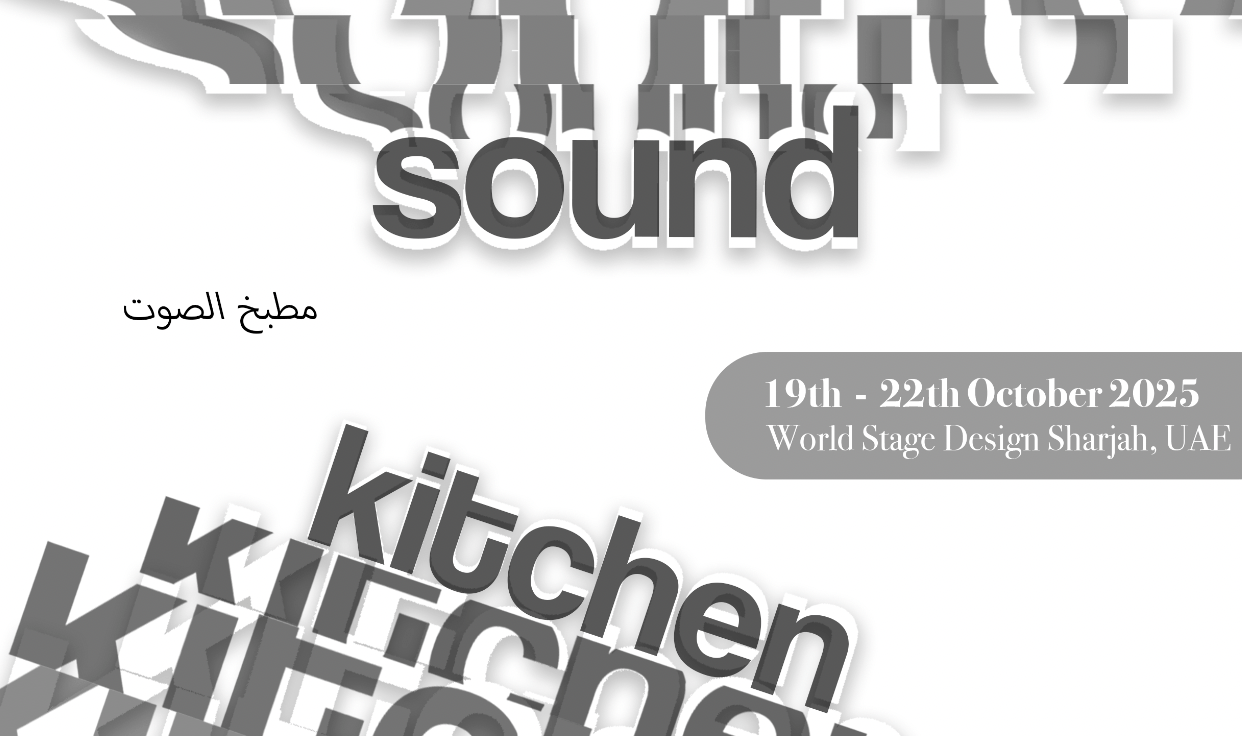
Sound Kitchen (SK) is one of our favourite events to perform at! It happens every 4 years as part of the Prague Quadrennial (which takes place in Prague), as well as every 4 years as part of the World Stage Design (which takes place in a different country each time and is organised by Organisation Internationale des Scénographes
Techniciens et Architectes de Théâtre or OISTAT).
The timeline for these two events overlaps, so Sound Kitchen actually happens every 2 years. Woohoo!!! The website says SK is “an opportunity for sound designers and composers who work in all forms of sound and performance to publicly present or perform their work in a listening-friendly space”. Having performed/presewnted FLO at SK five times in the past 10 years, we can totally vouch for the ‘listening-friendly’ aspect of it, as the community of sound practitioners that gathers every 2 years to celebrate different ways sound is being used in the performing arts, sound arts, and installation arts, is incredibly friendly, helpful, generous, supportive and all around AMAZING!!!
The last performance we did at Sound Kitchen was in 2023. We did it fully telematically as everything worked perfectly, and by everything we mean: a) everyone was able to connect to NMP platform SonoBus during rehearsals and performance; b) network speed at the Divadlo Inspirace venue in Prague was adequately fast for bi-directional streaming (upload/download); c) our lovely colleague, Robin Whittaker, was co-ordinating SK and was planning to be in Prague in person with his wonderful TiMax software and hardware and a whole bunch of speakers, and d) Roser was able to grab audio streams in Valenica, do a pre-mix and use it to drive visuals in Touch Designer, before broadcasting the whole thing on FLO YouTube channel (more details about all of this can be found here). So, not only did we have ideal conditions to pull off a fully telematic audiovisual performance (which we have been fine-tuning for a while), but FLO & Friends: Telematic City Jam – Prague also resulted in a very low level of ‘performance-related carbon emissions’, due to none of the FLO members travelling to the venue! So, a win-win on all fronts 🙂
Initially, we envisaged delivering Telematic City Jam – Sharjah performance at Sound Kitchen 2025 as a co-located/distributed performance, alongside a Masterclass on Networked Music Performance (which Nela was planning to do). As it turned out, FLO performing at World Stage Design was not as ‘fundable’ as we all thought it would be, at least not according to the Arts Council England, British Council and PRS Foundation
International Showcase Fund. This is not to say they didn’t like what we were doing (quite the opposite!), but WSD, as an event, just wasn’t ‘ticking the right boxes’ 😦
On top of this, we found out that the SK team would not be able to access the Sharjah Performing Arts Academy (where SK was taking place) until a few days before, which meant there was no way for us to test access/ speed of the network. So we decided to go ahead with the only feasible plan, which was to record the performance in advance and provide Robin with the separate stems so he can spatialise the sound in real-time.
We got together on Zoom to discuss the structure of the composition and brainstorm how the 4D-CubeHarmonic sequence (derived from the IBM quantum circuit calculations we used in our first quantum composition for Radiophrenia 2025 festival) could be utilised in the performance. The FLO quantum expert, Maria, was leading on this with various ideas, which Nela then translated into a 4D-CubeHarmonic track with specifically timed harmonic sequences. As it is quite challenging to play along with such a track (which contains many points of complete silence), Nela composed another track with soundscapes she recorded around the world and sent the mix of both tracks to Maria, who then created a score that everyone else could follow.

During the first rehearsal session, we discovered that connecting to Sonia (in Melbourne) and Nela (in London) was fraught with all sorts of network related issues, so we decided to go to Plan B, in which Magda was gonna play the track containing the mix of 4D-CubeHarmonic sequences and soundscapes on a different laptop and stream that as a separate track to her cello stream, connect to Ariane and Maria on SonoBus and record the composition.

Using a combination of asynchronously and synchronously recorded tracks in a recording session is a real treat, because the asynchronously recorded tracks can serve as a guide, and allow everyone else to ‘practice responding,’ which gets better and better with every pass, as everyone relaxes into the improvisation. Recording a composition in advance was also a bit of a luxury, as we got to choose the ‘take’ everyone liked the best, something that is impossible to do in a real-time telematic performance.
As per usual, we captured the full mix as well as the individual tracks in SonoBus, so once we decided on the take we loved the most, Nela was able to assemble the session in Digital Performer using the full mix to ‘line up’ the individual tracks. SonoBus seems to address the latency during the performance just fine, but the individual tracks captured on a hard drive locally always seem to be slightly ‘off’ 🙂 Because of this, some minimal editing always needs to take place before the individual tracks can be sent to 2 Aux tracks (one with Delay and the other with Reverb). We found that doing this gently offsets the varied reverberation captured alongside the sound at each of the remote environments where acoustic instruments and voice have been recorded.
Aux tracks were sent to the Master track, loaded with Compressor and Limiter plug-ins (by Waves, of course!) and the mix got uploaded to Google Drive so Sonia could add it to her Bitwig session and record her track (containing Melbourne soundscapes) in Melbourne 🙂 Nela then added Sonia’s track to the rest of the Digital Performer session (routing it to Aux 1, Aux 2 and Master) and exported the final version of the composition as separate stems ready to be ‘messed with’ spatially 🙂
Luckily for us, TiMax moved from Cambridge to Tileyard London (after joining the Focusrite group), so Nela was able to meet Robin at the studio and spend the whole afternoon playing stems, discussing different aspects of the composition that could be moved around in space, and talking about how frequencies from the stereo tracks, automatically separated into mono on import, could be separated across speakers and subs to get some very interesting effects. Needless to say, Nela was totally blown away by the creative sonic capabilities of TiMax!


Watching Robin expertly program the spatialisation of the composition with TiMax was quite a privilege for Nela, and even though it looked easy (when he did it!), it still took hours to get things just right. The process of listening, tweaking, listening, again and again and again, until it all makes sense ‘spatially’, is actually quite cognitively taxing (even with steady stream of coffee). After a few hours of mixing, their ears (and brains) got a bit ‘saturated’, so they decided to take a ‘listening break’, grab some fresh air, pizza, beer and cider 🙂

After the break, they wrapped up the mix and walked down to Kings Cross station to catch their respective trains home. Along the way they discussed the differences between doing the spatialization in real-time (like Robin did at Sound Kitchen 2022 in Calgary and Sound Kitchen 2023 in Prague), and spending an afternoon programing spatial automation and intentionally crafting the listening experience.
Doing things ‘offline’ provided an opportunity for Nela and Robin to completely ‘reimagine’ the original Telematic City Jam – Sharjah composition. Even though all the ‘sound events’ remained unchanged (in terms of time), when the frequencies were ‘spatially re-arranged’, the brain simply perceived them in a totally different way.
Doing a spatial mix using separate stems does something entirely magical, placing the listener ‘inside the sound’, transcending both the ‘aural’ and the ‘visceral’… After years of experimenting with ‘moving the sound around your head’ type of stuff, and being super excited about doing multichannel stuff with just 8 speakers (yes, a decade ago that was like wow!), it seems the era of multichannel immersive audio becoming mainstream has finally arrived! Just in time for the next FLO album 🙂
After sorting out the spatial mix, Nela sent the stereo mix to Silvia to create visuals and forward them to Robin, so he can run them in sync with TiMax.
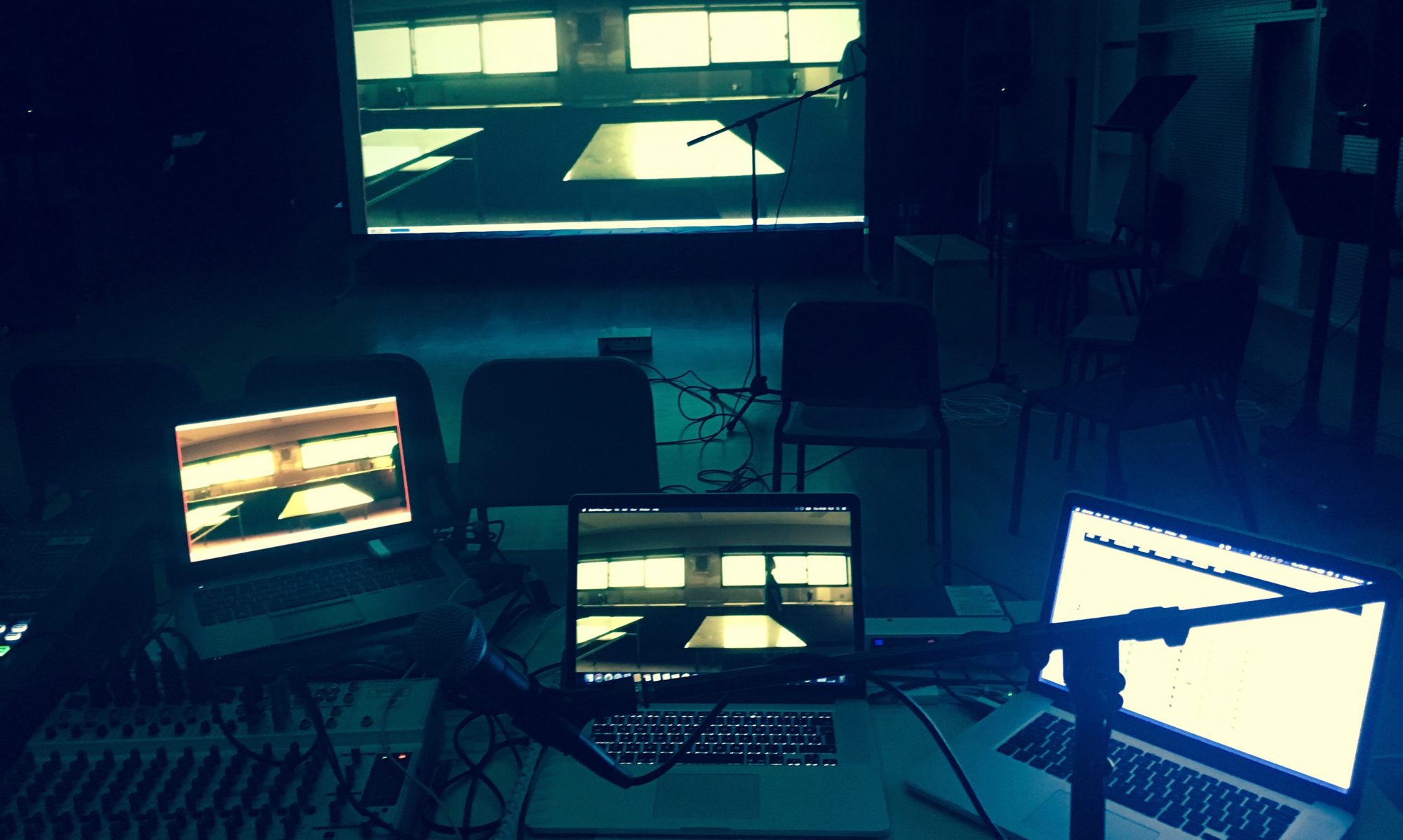
Below are a few photos showing how it all unfolded in Sharjah …


We were a bit sad we couldn’t get any funding to travel to Sharjah and hang out with all the wonderful SK community in person. However, thanks to Robin and Silvia, our composition, Telematic City Jam – Sharjah, was able to ‘travel’ all on its own (with a minimal carbon footprint!) and ‘be present’ at the Sharjah Performing Arts Academy in full colour, 45 speakers and 6 subs!!!
We raised the bar of what is possible within the field of NMP once again. Stay tuned to see what we come up with for SK2027!
A BIG THANK YOU to the following peeps and organisations who helped make this performance happen:
- The lovely Robin Whittaker (co-curator of Sound Kitchen 2025), who did an awesome job programming (at TiMax Spatial Studio in London) and spatialising the performance (at the Sharjah Performing Arts Academy), using audio hardware and software system TiMax.
- The awesome Peter Rice (co-curating SK with Robin) and the rest of the equally awesome Sound Kitchen team
- Our gear sponsors: Bitwig Studio, Audio-Technica, RØDE Microphones, PreSonus, NETGEAR, WAVES, BCSWomen, and Rogue Amoeba.
 FLO
FLO 